


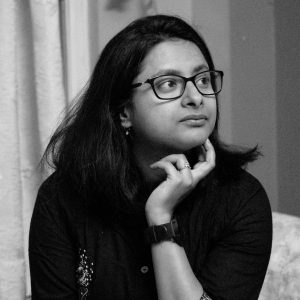
Personal Information:
- Postdoc at the University of Murcia, Spain.
- Ph.D. at the University of Gdańsk , Poland.
- Email: m.pandit@um.es
Background and Research interests:
My current research goal broadly includes investigating thermodynamically relevant protocols whose characteristics cannot be fully understood classically. By investigating the thermodynamics of such systems, we aim to provide a much-needed conceptual bridge between non-classical advantages and fundamental quantum phenomena.
Quantum Thermodynamics and Open Quantum Systems – I am currently working on accurately describing the thermodynamics of nanoscale devices where quantum effects become relevant. I am focusing on a nanoelectromechanical device where currents and their fluctuations can encode essential information about the system. I am studying these current fluctuations and the ways to mitigate them from a thermodynamic point of view. (see [1])
Foundations of Quantum Mechanics – My doctoral thesis was partly focused on taking novel directions towards understanding notions of strong non-classicality and utilising them as resources to gain advantages that serve as the backbone for current and future quantum technologies. In this regard, I investigated the role of resources such as entanglement and Bell nonlocality in ‘genuine multipartite’ scenarios as well as the dependencies between subsystems within such composite settings.
Selected Publications:
- [1] Autonomous oscillations in quantum electromechanics: tensor network treatment, MP, S. P. Mandal, M. T. Mitchison, J. Prior. arXiv 2605.27326 (2026).
- [2] Heat operator approach to quantum stochastic thermodynamics in the strong-coupling regime, S. P. Mandal, MP, K. Mahadeviya, M. T. Mitchison, J. Prior. Phys. Rev. Research 8, 013321 (2026).
- [3] Current fluctuations in nonequilibrium open quantum systems beyond weak coupling: a reaction coordinate approach, K. Mahadeviya, S. V. Moreira, S. P. Mandal, MP, J. Prior, M. T. Mitchison. New Journal of Physics 28, 044511 (2026).
- [4] Quantitative nonclassicality of mediated interactions, R. Ganardi, E. Panwar, MP, B. Woloncewicz, T. Paterek. PRX Quantum 5, 010318 (2024).
- [5] Exclusion principle for nonlocal advantage of quantum coherence, P. Ghosh, MP, C. Srivastava, U. Sen. Phys. Rev. A 108, 022410 (2023).
- [6] Optimal tests of genuine multipartite nonlocality, MP, A. Barasinski, I. Marton, T. Vertesi, W. Laskowski. New Journal of Physics 24, 123017 (2022).
- [7] Recycled entanglement detection by arbitrarily many sequential and independent pairs of observers, MP, C. Srivastava, U. Sen. Phys. Rev. A 106, 032419 (2022).
Ph.D. thesis:
Characterization of quantum correlations with strong non-classical properties (June 2022).
Talks:
- Exact simulation of the dynamics of open quantum systems in the strong coupling regime, University of Oxford, Oxford, United Kingdom. (April 2025)
- Fluctuations in the Anderson-Holstein-type model, University of Malta, Malta. (September 2024).
- Tensor network simulation of the dynamics of an Anderson-Holstein-type model, Chalmers University of Technology, Gothenburg, Sweden. (April 2024).
- An ITensors implementation of a dissipative e-dot coupled to a HO, ASPECTS Scientific Meeting, Annecy, France. (December 2023).
- Recyclability of genuine multipartite entanglement, The Hebrew University of Jerusalem and Weizmann Institute of Science, Israel. (March 2023).
- Characterization of strong non-classical correlations, Institute of Theoretical and Applied Informatics, Polish Academy of Sciences in Gliwice, Poland. (April 2022).
Hobbies:
I enjoy photography as a creative outlet and a way to unwind outside of research. A few of my photos are on Flickr.